There is a familiar story — particularly common in American circles — about a common method professional sports bettors can use to make money. Recreational bettors like betting on favorites, particularly popular teams with star players. Bookmakers know this and adjust their odds accordingly, so bets on these teams give worse returns. Professional bettors then exploit these distorted prices by betting against the public.
In a recent article in The Athletic, Chad Millman uses Patrick Mahomes and the Kansas City Chiefs to illustrate this phenomenon. Despite Mahomes being one of the greatest quarterbacks of all time, betting on the Chiefs to cover the point spread when they are favorites has been a consistently losing proposition.
Millman argues that this illustrates how professional bettors make money by taking the opposite side of bets placed by the public. As he puts it:
The more bets that come in on the public team, the more the point spread increases, the better value there is in betting the other side.
There is plenty of evidence that the public likes betting on favorites and that bookmakers take this into account when setting their odds. But there is an important distinction missing from this story.
The fact that betting on favorites is particularly unprofitable doesn’t mean betting on underdogs is profitable.
And research I conducted for my book, Fine Margins: How Economics Explains Sports Betting, suggests this distinction is important.
Fine Margins reports the returns to point spread bets using three large historical datasets: 24,672 NCAA basketball games from 2020 to 2025, 22,118 NBA games from 2008 to 2025, and 6,937 NFL games from 1999 to early 2026.
Returns to bets on games with strong favorites
For each sport, I divided games into five groups according to the size of the point spread. I then calculated the average percentage return from betting on favorites and underdogs in each group. Games ending in pushes were excluded, and the NBA calculations use standard -110 odds.
The results for games involving the strongest favorites are striking.
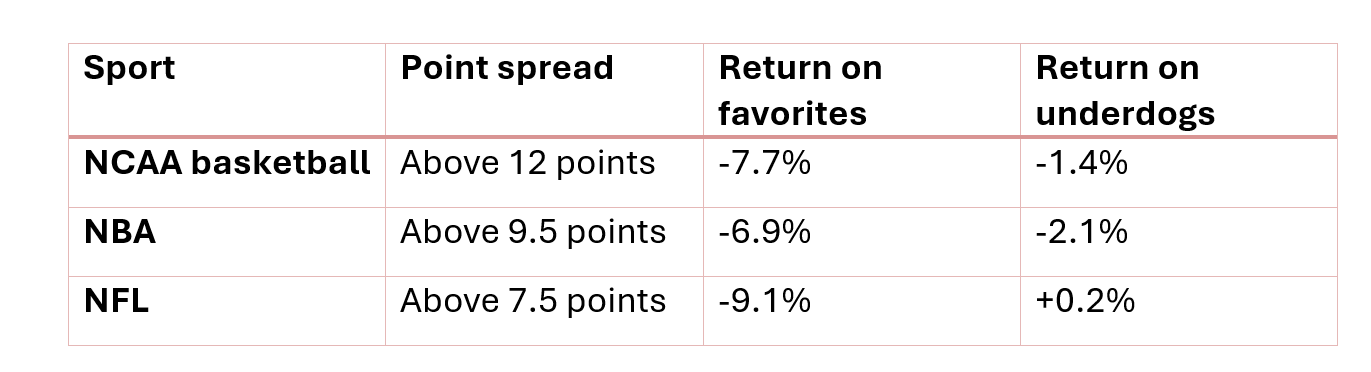
In all three sports, betting on strong favorites is a particularly bad idea. The average losses range from almost 7% for NBA games to over 9% for NFL games.
The bad returns on favorites are driven by a simple pattern. At typical point spread odds of -110, both sides of the bet need to win about 52.4% of the time to break even. If the point spread is set correctly, we would expect each side to cover about half the time, producing losses of approximately 4.5%.
But the strongest favorites don’t cover half the time. In my sample, their cover rates are 48.5% for college basketball, 48.9% for the NBA and just 47.5% for the NFL.
So the data are consistent with the idea that bookmakers shade point spreads against strong favorites, giving them a tougher handicap than they would have if the market were simply trying to produce a 50-50 bet.
This is exactly the kind of pattern that Millman’s article describes.
But what about the professional bettors supposedly making money by betting against these favorites?
Look at the final column of the table.
Betting on the underdogs against these strong favorites produces much better returns than betting on the favorites. But it doesn’t produce much in the way of profits.
In college basketball, betting on these underdogs loses 1.4%. In the NBA, it loses 2.1%. And in the NFL, the average return is a tiny positive 0.2%, an amount far too small to be considered convincing evidence of a profitable strategy.
Looking at all games
When we move on from looking at games with very strong favorites, backing underdogs against the spread clearly loses money. From the same dataset, the results for backing favorites and underdogs against the spread is as follows.
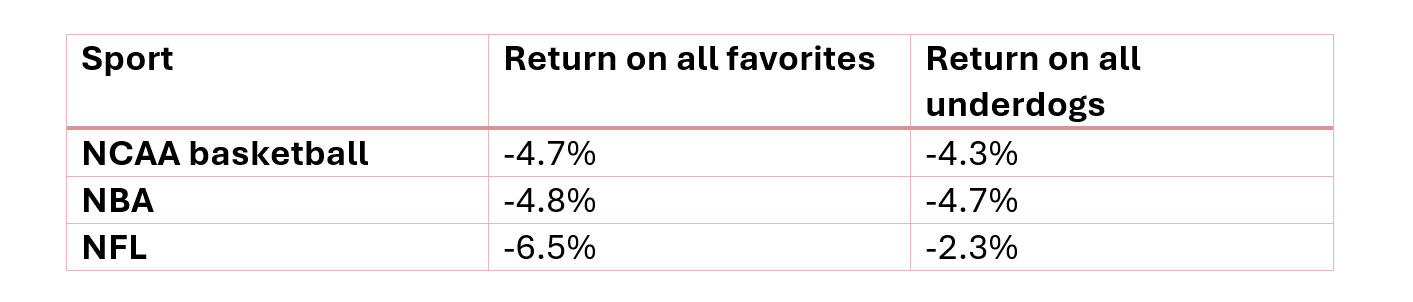
In basketball, there is essentially no difference between the overall returns on favorites and underdogs. In the NFL, betting on underdogs does substantially better, but still loses money.
There is a useful lesson here. It’s pretty easy to find evidence that some types of bets are bad and you would do better taking the opposite side. But that’s not the same thing as taking the other side actually makes you money.