In earlier posts, I explained that bookmakers set odds using two ingredients: their assessment of the probability that a bet will win and a built-in profit margin.
But if you ask the internet how bookmakers set odds, you will generally get a very different answer.
Book Balancing
When I asked Google “how do bookmakers set odds?” its AI summary told me about bookmakers “tweaking the lines … to balance their books and ensure profit regardless of the result.”
The top answer to this question on Reddit also affirms “They tweak the payouts so that no matter the outcome, one side is paid out less than the other side bet leaving them a profit.”
And Wikipedia, on its “Mathematics of bookmaking” page asserts that “A bookmaker strives to accept bets on the outcome of an event in the right proportions in order to make a profit regardless of which outcome prevails.”
This idea has also appeared in papers that academics have written about bookmakers. A famous paper in the Journal of Finance said “The bookie has no desire to participate as an active gambler. Rather, he establishes a line or price to balance the wagers so that his commission is independent of the final outcome of the contest.”
The book balancing idea implies bookmakers set odds very differently from how I have described them. I have said their estimate of the probability that a bet will win is crucial. But if bookmakers adjust their odds so they have an equal exposure whichever team wins, then they don’t even factor probabilities into their pricing.
Suppose bookmakers think odds of 3 on the Dallas Cowboys represent a profitable price because the Cowboys are unlikely to win. If balancing books were really the objective, that probability judgment wouldn’t matter. If the balance of money was coming in on Dallas, they would start cutting the odds below 3, until people stopped betting on Dallas the volumes were balanced. The public’s betting demands, not the bookmaker’s probability estimates, dictate the odds.
Google, Reddit, Wikipedia, decades of academics.
They can’t all be wrong, can they?
Well, it turns out they can.
Bookmakers Tell Us They Don’t Balance Books
I think most people who claim bookmakers focus on balancing books have never spoken to one. I have. My co-author Tadgh Hegarty is an experienced bookmaker. When I started asking him how the betting world worked, one of my first questions was “do bookmakers adjust odds down when volumes go up so they have balanced books?”
He could not have been clearer: Hell no, that is not what we do. Taking risk on individual events is just part of being a bookmaker. He told me the goal was to make as much profit as possible averaged over all the bets, not to minimize the risk for each event.
I began reading more about the subject. I read an interview with Jay Kornegay, longtime head of the Westgate Superbook and perhaps the most famous Las Vegas bookmaker, about how he set odds.
When asked about balancing books, Jay said “I think there’s a little urban legend that’s out there, that we just want to balance every game … In a perfect world, yeah. But … it just doesn’t happen. You go through every single game today and probably none of them … are balanced on both sides. That scenario right there, it just doesn’t happen.”
Between Tadgh’s explanations and Kornegay’s discussion of his strategy, I realized my earlier line of questioning didn’t really make sense.
I am an economist. We teach our students that businesses seek to maximize profits. Bookmakers are businesses. Why would they operate in a way that focuses on minimizing risk? Why would they not also seek to maximize profits?
The Economics of Brooklyn Gangsters
Then I came across perhaps my favourite ever economics paper, one that, remarkably, was never published in an academic journal. I knew Koleman Stumpf from my days at graduate school at MIT as an incredibly sharp and funny guy. So it was fun to see he had the definitive paper showing the book balancing idea was just not correct.
Koleman’s paper relied on a remarkable dataset. From 1995 to 2000, the Brooklyn District Attorney’s office prosecuted a series of illegal bookmakers and made their records available after the cases had been resolved. That the illegal bookmakers kept such detailed records raises the question associated with Stringer Bell from The Wire: “Is you takin’ notes on a criminal f—in’ conspiracy? What the f— is you thinking, man?” But thankfully for us they did, and Koleman found a treasure trove of data showing how actual real-world bookmakers ran their businesses.
Strumpf’s evidence showed the conventional wisdom among economists about bookmakers was completely wrong. He wrote “Bookmakers are thought to be perfectly diversified and to profit only from commissions. This would require implausibly risk averse preferences and is inconsistent with actual practices. I find that bookmakers gamble and take positions on games. The resulting variation in net revenues is substantial, with one large bookmaker often winning or losing one hundred thousand dollars per day on a daily bet volume of a half million dollars.”
DraftKings Just Blurts It Out
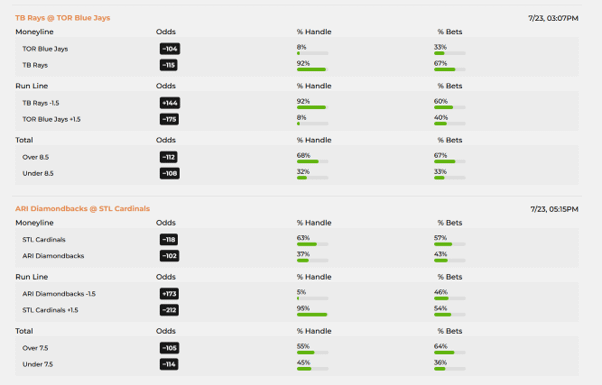
Having carefully collected nuggets of information and research on how bookmakers don’t balance their books, earlier this year I noticed that DraftKings, the second biggest US sportsbook, had started publicly announcing their betting volume splits. And guess what? Combining the odds and the volumes, the books are pretty much never balanced. DraftKings are taking a position on almost every bet, anticipating that all of this risk will even out over time so they get a predictable profit margin.
See below for 6 different markets on two major league baseball games taking place the day I am writing this. The data here are typical. There are very few lines even close to a 50/50 balance in percentages of handle and plenty of highly uneven splits.
As an aside, I would note you sometimes read stuff about how “shading the public” is the way to make money. But you can be 100% sure that DraftKings would not release these betting volume splits if there was any information in it that would help you beat them.
Maximizing Profit, Not Minimizing Risk
So bookmakers do not simply minimize risk on each event. I suspect the reason people focus on the book balancing idea is because it is easy to understand. And there is very little established research out there on the obvious alternative approach: how a bookmaker that wanted to maximize profits might go about doing it. I will come discuss this in my next post.