Multi-leg bets go by many names. You pick a set of bets and if your first bet wins, your return rolls on to your second pick and if that wins your winning are placed on the third pick and so on. You only get money back if all your picks win. Americans call them parlays. In Britain and Ireland they’re accumulators or bet builders. Australians call them multis. The French call them pari combiné.
Whatever you call them, they are popular with bettors worldwide. But they are even more popular with bookmakers because they are their most profitable products.
I have been describing how bookmakers set odds by combining their estimate of the probability that a bet will win with a built-in expected profit margin. A useful benefit of this framework is it helps to explain how much of your money you will get back on average from playing multi-leg bets.
The Grim Arithmetic
Bookmakers set decimal odds (the total payout you get if you win) according to the formula
where p is their estimate of the bet’s likelihood of winning and m is their expected profit margin.
Now imagine placing $1 on a 5-leg accumulator bets on 5 different games. For simplicity, we will assume the odds on all the games are the same (nothing important below is changed by picking a set of bets with different odds).
How much might you win? If the first leg wins, you would get back $D if it was a standalone but, in this case, you would be placing the $D on the second leg. If that wins, you then have $D2 to place and if that won … well you get the idea. If all legs win, you will have turned your one dollar into $D5 . This is an exciting win — congratulations!
But how likely are you to win all the legs? Let’s assume the bookmaker’s probabilities are correct. Bookmakers are not perfect but they are typically highly profitable — their assessments that they are going to win on average are typically correct. So you have a probability p of winning the first leg. Once you have won that, you again have a chance p of winning the second leg. These are independent events so the basic laws of probability mean you have a chance p2 of winning both legs. For example, if p = 1/2, then you will win the first two legs one-quarter of the time.
Carrying this further, your probability of winning the accumulator bet is p5 and your probability of losing is (1-p5). This means the expected payout on your $1 bet — the amount you will get back on average if you place many of these bets — is
Pick a typical retail margin of 5% so m=0.05 and your expected payout on the $1 bet is 77c. That’s a hefty loss rate of 23% even though the separate individual bets only have a 5% margin.
Every additional leg compounds the bookmaker’s edge. A five-leg accumulator is not five ordinary bets. It is the bookmaker’s profit margin applied five consecutive times to the same bet.
Losses By Leg Count and Odds Boosts
Five is a fairly popular number of legs for retail bettors but things only get worse as the number of legs gets bigger since (pD)N gets smaller as N gets bigger.
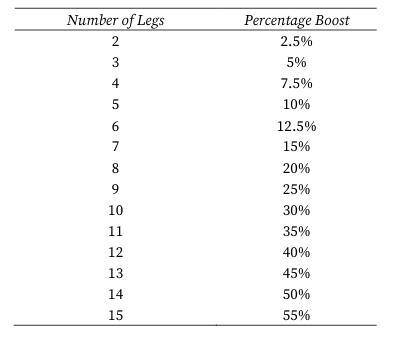
This explains why plain vanilla accumulators are bad, but bookmakers tend to offer more attractive versions than simply combining the individual bets at their separate odds. For example, many bookmakers offer odds “boosts” if you place an accumulator, with bigger boosts the more legs you add. The table below shows an example of an “Acca boost” percentage offer available from a UK bookmaker. They go from a modest 2.5% boost on two legs to a massive 55% boost if you take fifteen legs.
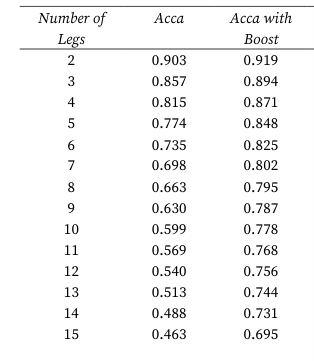
This sounds great – the prospect of a big win and you’re getting boosted odds. But, in truth, these boosts only slow the decline in your expected payout. It remains the case that you lose more money on average by taking more legs. The table below shows the expected payout rates on accumulators from a $1 bet with each leg having decimal odds of 1.9 and a 50% probability of winning, implying a 5% margin.
What Drives This?
This may seem unintuitive. You pick a set of bets you like the look of. The bookmaker offers you boosted odds and yet you end up losing way more money. But the reality is that across all the bets they offer, the bookmakers have an edge. Bettors regularly win money but the best thing for a bookmaker once someone has won a bet is to get them to risk that money again with another bet. That ever-declining expected payout is just the bookmaker’s edge being compounded over all the legs.
For example, if instead of a $1 bet on the accumulator, you had placed 20c separately on each match, your expected payout would have been 95c rather than 77c. Indeed, if you had placed the $1 just on one match, your expected payout would have been 95c. Placed separately, these bets have a modest margin, placed as an accumulator, the underlying margin explodes.
Near Wins
The arithmetic is simple enough and grim. But people often still feel like they have a better chance of winning than they do. One reason for this is accumulator bettors sometimes experience “near wins” which convince them they might win next time. But frequent near wins on modest-length accumulators are a feature and they don’t change how bad the bets are.
Suppose you place a series of bets where you have a 50% chance of winning (W) or losing (L).
Let’s work out what the different possible outcomes will be through the first four legs.
After one leg, these 2 outcomes are equally likely:
W, L
After two legs, these 4 outcomes are equally likely:
WW, WL, LW, LL
After three legs, these 8 outcomes are equally likely:
WWW, WWL, WLW, WLL, LWW, LWL, LLW, LLL
After four legs, these 16 outcomes are equally likely:
WWWW, WWWL, WWLW, WWLL,
LWWW, LWWL, LWLW, LWLL,
WLWW, WLWL, WLLW, WLLL,
LLWW, LLWL, LLLW, LLLL
Look at the equally likely outcomes above after four legs of an accumulator where each leg has a 50% chance of winning. Four of the sixteen possible outcomes showed all but one leg winning but only one out of sixteen won every leg. Four near misses. One big win.
This generalizes to adding more legs. You place a five-leg accumulator and all of them win apart from one. So close, right? But that situation will happen five times more often than winning all five legs, so maybe not so close. As you add more legs, being one leg short becomes increasingly more likely relative to winning them all.
What If You Have An Edge?
The following thinking is tempting. Sure, the bookmaker has an edge on most bets, but I have scanned this weekend’s matches and I am pretty sure I have an edge on these 5 bets. I think they have a positive expected profit. This means pD > 1 and (pD)N gets bigger as I pick a higher N by adding more legs. It is my edge that is being compounded, mwah-hah-ha!
Well, ok, galaxy brain, do you have a track record of regularly picking 5 excellent winning bets each weekend? If so, maybe you can quit the day job and become a professional bettor. But most likely your account balance suggests the opposite.
But, let’s go with it for a minute. Let’s suppose you do really have five bets with an edge. Should you really place an accumulator bet? Adding more legs increases the expected value of your profit. But it also makes it much more likely that you won’t win. Even with an edge, this strategy relies on very occasional big wins to offset lots of losing. In statistical terms, it is a high-variance strategy.
There is a whole field called financial economics built around that while people like higher average returns, they dislike high variance in returns. We build models around this idea — people having utility functions based on disliking variance. In a recent research paper, I show that even people with a decent-size edge on their bets should not place them as parlays if they have risk-averse preferences. This applies even to people who are much less risk-averse than empirical studies usually document.
Follow the Money
A final observation. As the guy in All the President’s Men said, if you want to understand something, you need to follow the money. Parlays/accumulators are widely advertised and that costs money, so you can be pretty sure that this extra cost is covered by bookmakers earning higher profit rates for bookmakers. And this means higher losses for bettors.
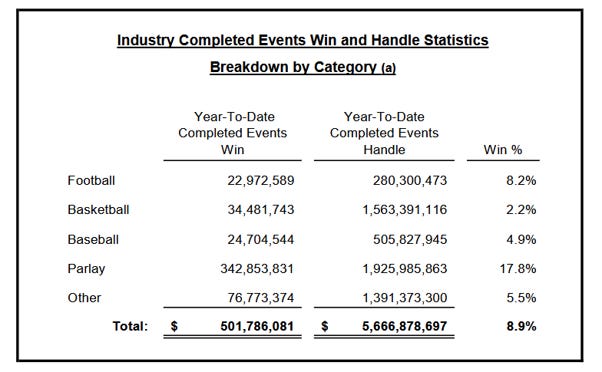
Don’t take my word for it. Some US states require bookmakers to report betting volumes and revenues separately for different types of bets. These reports consistently show far higher profit margins on parlays than on ordinary single-game bets.
Here is the New Jersey reporting site. The June 2026 figures are below. The “win percentage” is the win for the bookmakers, not the bettors. Non-parlay bets lost 4.3%. Parlays lost 17.8%, more than four times worse.
If you want your bankroll to go further, or give yourself some chance of winning, you need to quit placing multi-leg bets.