You place a bet 24 hours before the game on a team and then see the closing odds were worse than you got. This means you got what is known as closing line value. You got a better deal than if you showed up at the last minute to place the bet.
In modern American sports betting discussions, closing line value has an almost mythical status. The logic goes like this. By the time the game starts, every last piece of useful information has been baked into the odds. If the odds move after you have placed your bet in a way that indicates its percentage of winning has gone up, that suggests you had more useful information when you placed your bet than the market had yet factored in. That shows you have skill as a bettor. Here is a good example of the type of article you see on this.
But the key message from these discussions — that getting positive average CLV means you will win at sports betting — is largely wrong.
The CLV Religion
To give a flavor for what people say about CLV, I asked Google Gemini to tell me about the importance of getting closing line value for winning in betting and got this response: “In sports betting, Closing Line Value (CLV) is the ultimate metric for separating long-term winners from people who just get lucky. If you want to know whether you are going to make money over thousands of bets, you don’t look at your short-term win-loss record — you look at your CLV.”
You see this debated all over Reddit threads where people explain they’ve been betting for six months and have lost but have kept a record and they have positive CLV. They are assured to stick at it – they are skilled bettors and will win over the long-term.
The logic of hunting for CLV comes with its own advice: bet early, when lines may not fully reflect the correct information on the game, giving you a better chance of getting a good deal.
This CLV religion has a notable high priest. None other than Spanky, America’s most famous and beloved sports bettor. Spanky has declared “It’s better to lose a bet that beat the closing line than win a bet that didn’t beat the closing line. The former guarantees you long term success while the latter guarantees you go broke.”
Spanky is undoubtedly one of the good guys in the American sports betting landscape and he’s a millionaire and I’m not. So take what I am about to say with that caveat. But getting CLV does not guarantee that you will win long-term. At all.
An Example: NBA Moneylines
My book, Fine Margins, has detailed calculations on this topic, so here I will confine myself to one market: NBA moneylines. A reason to pick this market is that, unlike most sports betting markets, NBA moneylines are an efficient market, with no favorite-longshot bias (I will come back to why this is in a future post).
From The-Odds-API.com, I collected quotes on moneylines for every NBA game from the 2022/23 season to the 2024/25 season. That’s 3,670 games. Quotes were collected one full day before tip-off and also eighteen hours, twelve hours, six hours, one hour and ten minutes before from a range of licensed American sportsbooks. The result was 34,944 quotes for each time-stamp, so an average of ten books for each potential bet.
From this sample, I constructed a “closing line” as the median across the sportsbooks of the final quote available just before tip-off. Each pre-game odds quote was then compared with this and closing line value was calculated. Game results were taken from the NBA’s official statistics API site, allowing us to measure the performance of each bet and to measure average performance across different levels of CLV.
I measured CLV as the percentage improvement in decimal odds that you got relative to the closing odds. Then I ordered all the odds quotes by ten “deciles” from the worst group to the best and measured how you would have performed if you had placed these bets. As you would expect, about half the bets had positive CLV (the odds declined after the quote was recorded) and the other half had negative CLV. And the bets with positive CLV did better than the bets with negative CLV. Getting better odds is a good thing.
But look at the loss percentages. Three of the five deciles with positive CLV but did not , on average, make a profit. The bets in the ninth decile got an impressive average CLV of 5% but only eked out a 0.2% profit. So it is only the top 10 percent of moneyline bets that managed to turn CLV into meaningful profits — an average positive return of 11.4%. Clearly, getting positive CLV does not guarantee winning money.
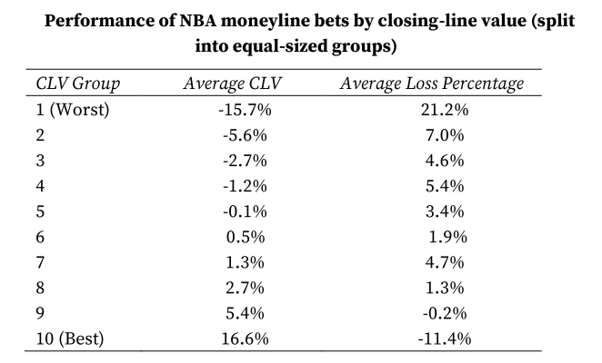
This table is based on the full sample of quotes from up to 24 hours before tip-off. If you just look at the 24-hours-prior sample, you find a similar pattern but more variance. Again, only the top decile wins any significant money but, in this case, its average profit is 16%.
So yes, there is a good return to finding misaligned odds the day before a game. But the lowest decile in this sample lost 25%. If you take the advice of CLV gurus and bet early looking for value, how sure are you that you are the plus 16% guy rather than the minus 25% guy? Most likely, you get equal amounts of good and bad luck with these picks, so you get an average loss rate of 4.5%. Just like everyone else.
I am not going to report more results — I can’t give away the whole book before it’s published. But the news doesn’t get better when we look at other sports. In college basketball, for example, the easiest way to get CLV is to bet early on serious underdogs. But the closing line odds on those bets are so bad that even tons of CLV isn’t enough for you to win.
Why CLV Disappoints
The CLV gurus never actually tell you how to get positive CLV but it might be disappointing to find out that even if you manage it, you are still most likely to lose money. What is going on?
Positive CLV means you got better value than the people who placed final bets. Great. By definition, getting higher odds is better than lower odds. But your bottom line doesn’t depend on the odds other people got, just the ones you got.
And the truth about winning is still precisely what I have been posting about from the start. Every odds quote is based on a probability estimate and a margin. To make money, you need to pick bets that are more likely to win than the sportsbook was assuming, but that gap in probabilities needs to be big enough to beat the margin they built in. For NBA, that’s a 4.5% profit margin. And that is enough for you to get significant CLV and still lose on average.
Getting CLV means the market decided your bet had a better chance of winning than the sportsbook assumed when you placed the bet. Congratulations. That’s nice. Markets are pretty good at absorbing information and the market consistently moving in your direction is an indicator that you may be skilled at making picks. Maybe knowing you have positive CLV makes you feel better, but feelings don’t add to your bank balance.
Why is CLV Guidance So Popular?
So the widespread guidance that getting CLV means you will win in the long run is bad advice. Why, then, is this advice so ubiquitous in the US? I think it stems from the recent nature of the market, which means that plenty of people are still relatively new to it. And guess what, most of them are losing.
At that point a natural instinct is go online and figure out what’s going wrong. You come across debates about CLV and start making calculations. You work out that you have positive CLV and go back and ask the forums whether you should stick at it. They tell you for sure, keep going. You are a skilled bettor, and you are going to win in the long run.
As with many online discussions, this is often just the blind leading the blind but there are two clear exceptions.
The first is people like Spanky, who know the business inside out and mean well but have boiled down their message to the point where it is misleading. Spanky knows well that you need enough CLV to beat the margin. On a 2021 podcast, mainly given over to extolling CLV as a metric, he said “so let’s say you’re not beating the closing line by enough to overcome the bookmaker’s vig. You gotta beat it enough to overcome the bookmaker’s vig.”It turns out this isn’t a small qualifier. This is the qualifier that turns most positive CLV bets into money losers.
The second is darker. Much of the advice on the internet about sports betting comes from helpful-looking sites that offer you sporting analysis, advice on picks and point you toward bonus deals. In the industry, these are known as affiliate sites because they send their readers to the sportsbooks and earn fees for their readers signing up. Indeed, revenue sharing deals are common: the more you lose after your referral, the more the affiliates earn.
The result is a rotten culture of faux advice that is best ignored. The people who run these sites are generally plenty sharp and know well that getting CLV does not guarantee that you profit. They just want you to keep betting. And keep losing.